


- Messages
- 4,013
- Likes
- 1,873
- Points
- 2,130
Google announced new Android security mechanisms designed to protect against scam messages, fake bank calls, and call forwarding abuse. Threat detection will utilize the Gemini cloud-based model and the Gemini Nano local model. The new features will gradually roll out to supported Android devices.
As Google explains , mobile fraud has long since moved beyond simple phone spam and phishing SMS messages. Fraudsters are increasingly resorting to number spoofing, sending fake bank notifications, and using AI to clone voices.
According to the company, existing protections in Google Phone and Google Messages detect more than 5 million suspicious calls and messages monthly, and the new tools should further enhance fraud detection.
One of the key innovations will be cloud-based analysis of Google Messages conversations using Gemini: AI will examine the context of conversations with unknown senders and identify signs of fraud. It is emphasized that message processing will occur in an isolated Private AI Compute environment, designed to protect data privacy. Furthermore, the new feature will be disabled by default, requiring users to enable it manually.
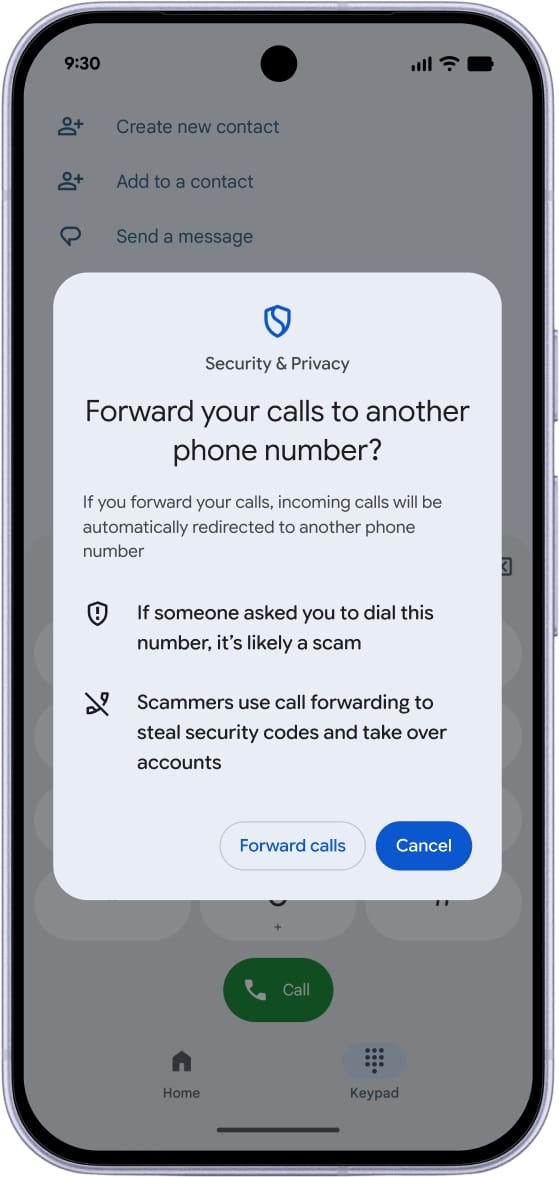
The local Gemini Nano model will be able to check suspicious links using up-to-date web threat intelligence in real time. Furthermore, users will be shown more explicit warnings before clicking links received from unknown numbers. Google is also expanding its fraud protection in third-party messaging apps. AI will analyze incoming messages directly through notifications and warn users about suspicious content even before opening a chat. This feature was previously available on Pixel smartphones, and is planned to be rolled out to hundreds of millions of devices from other manufacturers by the end of 2026. Android has also expanded privacy protection during screen sharing: the system will now hide authorization fields and payment information in Chrome and Android WebView during screen sharing. The developers have also paid special attention to call forwarding fraud. Android will no longer allow apps to silently enable call forwarding in the background, and users will see a warning before manually entered MMI codes are executed. Finally, Google is expanding the bank call authentication system, introduced earlier in 2026. This protection determines whether an incoming call is truly from a bank's call center or whether a spoofed number has been used. If the call cannot be verified, the system automatically terminates the call.

According to Google, since June 2026, this mechanism has helped block more than 3 million fraudulent calls for customers of Brazilian banks Banco do Brasil and Itaú Unibanco alone. Revolut and other financial institutions also already support this technology.
As Google explains , mobile fraud has long since moved beyond simple phone spam and phishing SMS messages. Fraudsters are increasingly resorting to number spoofing, sending fake bank notifications, and using AI to clone voices.
According to the company, existing protections in Google Phone and Google Messages detect more than 5 million suspicious calls and messages monthly, and the new tools should further enhance fraud detection.
One of the key innovations will be cloud-based analysis of Google Messages conversations using Gemini: AI will examine the context of conversations with unknown senders and identify signs of fraud. It is emphasized that message processing will occur in an isolated Private AI Compute environment, designed to protect data privacy. Furthermore, the new feature will be disabled by default, requiring users to enable it manually.
The local Gemini Nano model will be able to check suspicious links using up-to-date web threat intelligence in real time. Furthermore, users will be shown more explicit warnings before clicking links received from unknown numbers. Google is also expanding its fraud protection in third-party messaging apps. AI will analyze incoming messages directly through notifications and warn users about suspicious content even before opening a chat. This feature was previously available on Pixel smartphones, and is planned to be rolled out to hundreds of millions of devices from other manufacturers by the end of 2026. Android has also expanded privacy protection during screen sharing: the system will now hide authorization fields and payment information in Chrome and Android WebView during screen sharing. The developers have also paid special attention to call forwarding fraud. Android will no longer allow apps to silently enable call forwarding in the background, and users will see a warning before manually entered MMI codes are executed. Finally, Google is expanding the bank call authentication system, introduced earlier in 2026. This protection determines whether an incoming call is truly from a bank's call center or whether a spoofed number has been used. If the call cannot be verified, the system automatically terminates the call.
According to Google, since June 2026, this mechanism has helped block more than 3 million fraudulent calls for customers of Brazilian banks Banco do Brasil and Itaú Unibanco alone. Revolut and other financial institutions also already support this technology.